
15-minute cities: A new model in urban living

One of the challenges facing the residents of urban centers is the long daily commute. The time spent in their cars or on public transport getting to work, taking care of their daily tasks or simply going out downgrades their quality of life. For example, in 2024 drivers in Athens spent an average of 111 hours stuck in traffic. At the same time, people’s need to use motorized vehicles increases the environmental footprint in big cities.
15-minute cities offer an innovative approach that addresses the problem. These are cities where the residents don’t have to spend more than 15 minutes on foot or by bike to take care of their day-to-day needs.
A human-centric model in urban planning
The 15-minute city is a new model in urban planning, based on proximity to essential goods and services. The goal is not to travel an entire metropolis in 15 minutes, but rather to create individual zones where city dwellers can find anything they need close to their homes: work, shops, health and education infrastructure, and spaces for recreation and entertainment. In other words, these are cities within a city.
This approach limits the use of cars, motorcycles and public transport, and promotes walking and the so-called micromobility, meaning transportation with soft means, such as bikes or electric scooters. To this end, 15-minute cities prioritize pedestrian zones, bike lanes and sidewalks, instead of freeways and highways.
15-minute neighborhoods transform the residents’ daily life, by drastically limiting the time spent on transportation and instead freeing up time for things that are truly indispensable: strolls, hobbies and rest. Walking and biking have a low carbon footprint, improve health and well-being and, of course, are free. At the same time, streets become livelier, neighbors grow closer and the sense of community becomes stronger, while the smaller neighborhood shops are supported, since all the more people choose to meet their daily needs within this short radius.
From the neighborhood unit to the 15-minute city
The idea of the neighborhood unit was introduced as early as the 1920s, proposing the design of self-sufficient neighborhoods in urban centers, which were rapidly growing due to industrialization. A few decades later, around 1970, the term “compact city” was used to describe urban centers that developed within confined geographical borders and included mixed use of land, meaning they incorporated residences, shops and work spaces in specific areas or buildings.
An early version of the 15-minute city was implemented in 1994 in Poundbury, England, where the urban design was focused on easy access to public services. In 2016, the idea of the 15-minute city was established in France by architect Carlos Moreno, and became more popular on a global level following the COVID-19 pandemic. Today, it is promoted by C40 Cities, a network of 97 mayors from cities all over the world, including Athens, with the aim of addressing the climate crisis.
Examples from the world and the case of Athens
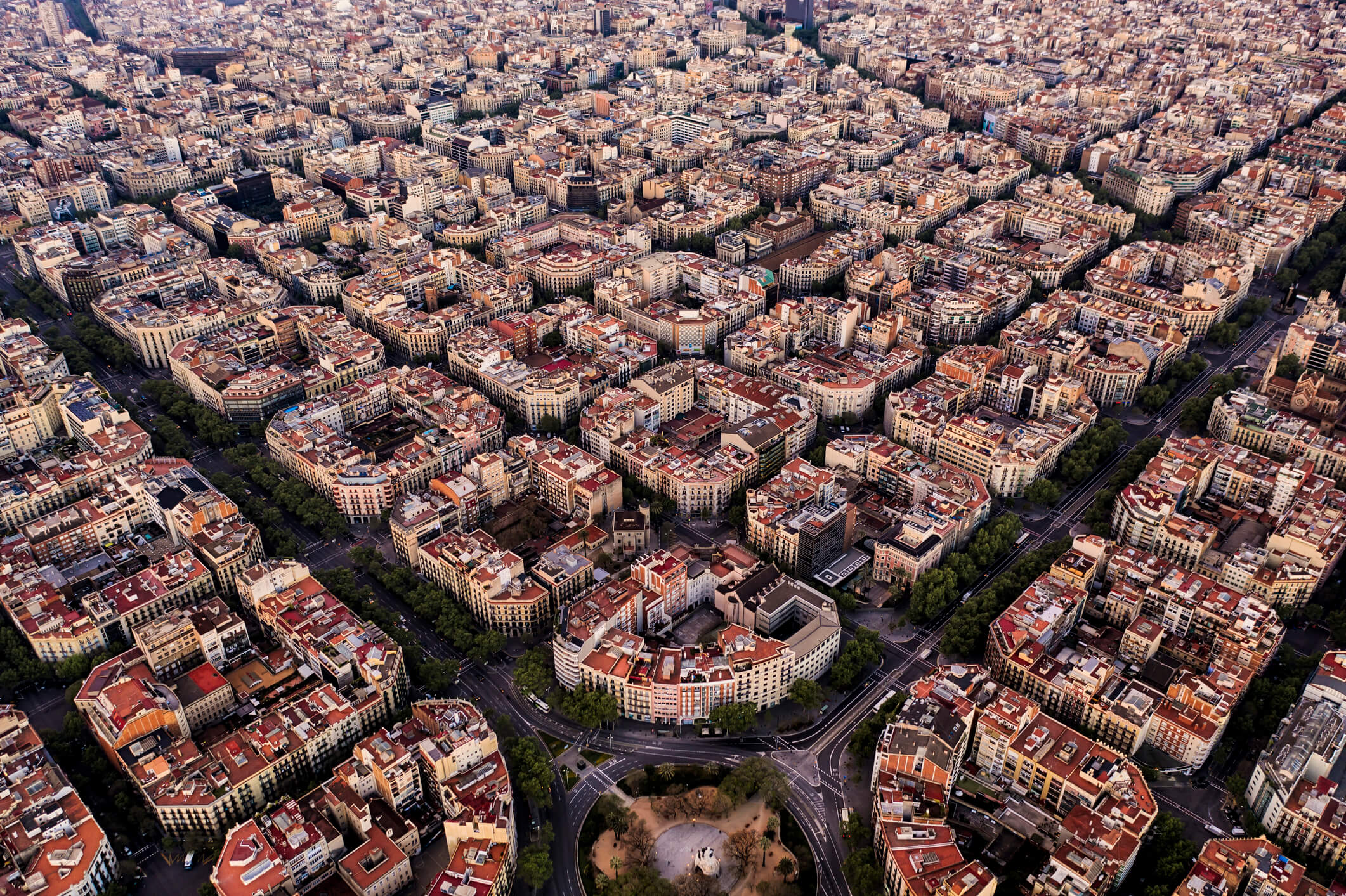
Over the last years, small neighborhoods with mixed land use have been created in Paris. For example, school yards are turned into small parks and thriving meeting places, hosting different after-school activities. Barcelona implements the superblock model: entire neighborhoods are organized in 400m blocks, where traffic-calmed streets prioritize pedestrians and bikes, creating a sustainable network of daily routes. Similar practices are adopted in Shanghai, Ottawa, Melbourne and Houston, Texas.
On the flip side, there are approximately 2.5 to 3 million cars in the Athens Metropolitan Area, i.e. the area that includes Athens, Piraeus and their suburbs. According to estimates about the area residents:
- 53% use their cars for transportation.
- 35% use public transport.
- 8% go to work on foot.
- 1-2% ride a bike.
These figures account for the frustration experienced by both drivers and pedestrians, since the space that is meant for them is constantly shrinking. It is obvious that radical solutions are needed to upgrade the quality of life for residents and visitors alike.
The Ellinikon: A 15-minute city on the Athens Riviera
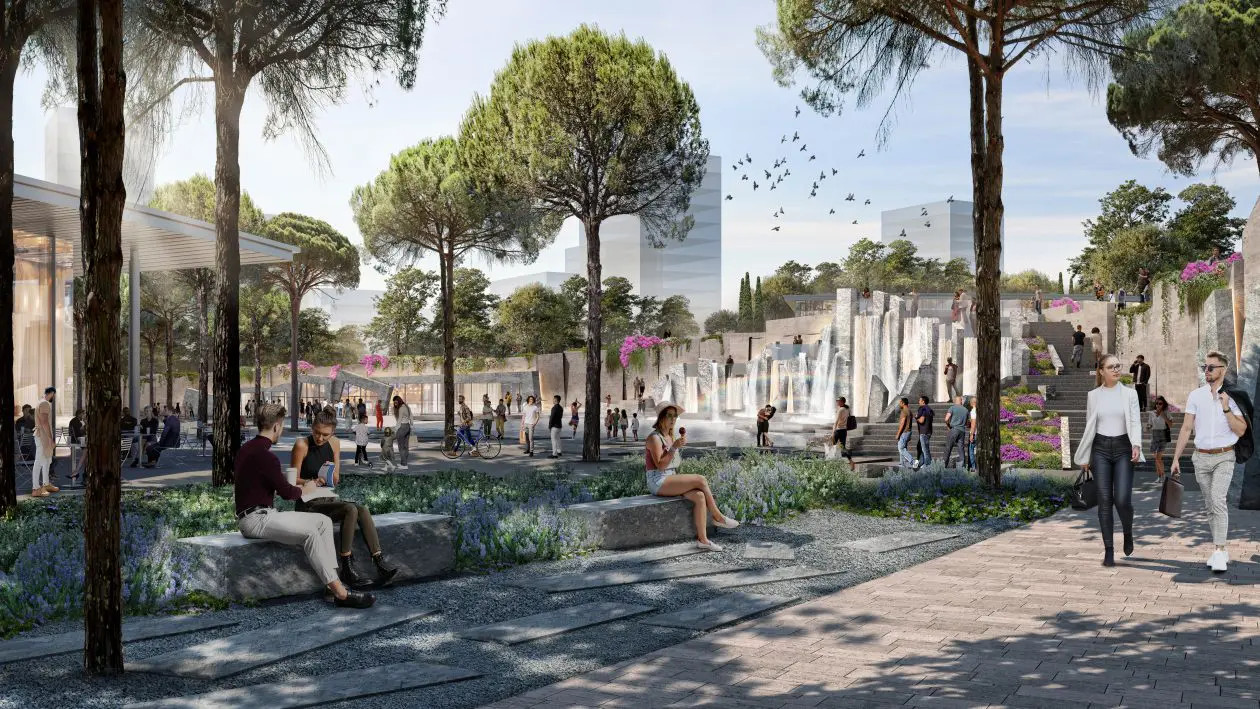
At The Ellinikon, we have a clear answer to these challenges, as, for the first time in Greece, we are designing an open and interconnected 15-minute city, which is redefining urban living. The new city will feature:
- Open green spaces – The Ellinikon Park will connect Mount Hymettus to the sea and will become the largest seaside park in Europe. Spanning 2 million sq.m, it will be 12.5 times larger than the National Garden of Athens and 1.5 times larger than London’s Hyde Park.
- Accessible coastal front – A sandy 1km-long beach will welcome residents and visitors, offering fun and relaxation. Also, the depression of a section of Poseidonos Avenue will reconnect the city to the seaside.
- Mixed-use neighborhoods – Most neighborhoods will combine residences, shops and business areas. People will be able to meet their basic needs for work, education, entertainment, health and shopping within 15 minutes.
- Micromobility network – An expansive network of routes, covering more than 50km, with pedestrian zones, bike lanes and traffic-calmed streets.
At LAMDA Development, we are transforming the urban landscape and the way people live, work and relax. We are creating sustainable, modern destinations that improve daily life, because we firmly believe that city life can be better for everyone.