
The Athens Coastal Front: then and now

Stretching across 70 kilometers of coastline from Piraeus to Sounio, the Athens Coastal Front is a uniquely beautiful area in the southern part of Attica, where nature, culture and cosmopolitan living blend seamlessly.
The vision of the Athens Coastal Front development emerged in the 1920s and started gaining increasing popularity in the 1950s. In fact, publications of the time spoke of a “new Côte d'Azur”, and areas such as Vouliagmeni, Varkiza and Lagonisi initially attracted local holidaymakers, before evolving into prominent tourist destinations.
A Mediterranean story
The first popular coastline was along the Ligurian Sea, in northwestern Italy. The Italian Riviera is an area with unique rocky landscapes, beautiful waters, picturesque fishing villages and luxurious resorts, such as Portofino and San Remo.
However, from the 19th century onward, the French Riviera, also known as Côte d'Azur, has become the quintessential meeting point of the aristocratic elite, thanks to its sun-drenched beaches, casinos and glamorous social scene. To this day, Nice, Cannes and the Principality of Monaco still retain their former glory.
The beauty and climate of the Mediterranean helped highlight other coastlines as well, which do not lack in charm, even though they are not as famous yet. The Spanish Riviera or Costa del Sol, the Dalmatian Riviera, as well as Turkey’s Turquoise Coast enchant visitors with their idyllic beaches, vibrant cities and distinctive Mediterranean character.

Nature and culture along the Attica coastline
When it comes to natural beauty, the Athens Coastal Front has nothing to envy of the European rivieras. From Palaio Faliro and Edem to Glyfada, Voula, Palaia Fokaia, Anavyssos and even beyond, beautiful and welcoming beaches follow one another in succession. Lake Vouliagmeni, with its thermal waters, is a true gem of the region, while the verdant Faskomilia Hill just above offers unique hiking trails with breathtaking views.
At the southern end of the Athens Coastal Front lies Sounio, where the Temple of Poseidon has stood for thousands of years. More than a landmark, it has become a ritual, especially on warm afternoons, when visitors of all ages gather among its Doric columns to witness the spectacular sunset. Around the temple, the Lavrio-Sounio National Park, the smallest in Greece, spreads out over an area of 35,000,000 m2. Along its beautiful trails, the aromas of the Attic land, from the pine forest, the holly trees and the strawberry trees, mingle with the salty sea breeze.
The Athens Coastal Front through time
As early as the 1920s, settlements began to form in what are now Athens’ southern suburbs, initially attracting holidaymakers and later on permanent residents. However, the construction of the coastal road after 1950 connected Elliniko, Glyfada, Voula and Vouliagmeni with Faliro and the rest of Athens. In 1954, the opening of the first of the two rocky tunnels on the Athens-Sounio Road, known as the "Karamanlis Holes", also connected the southernmost areas, from Varkiza to Lagonisi and Palaia Fokaia.
The construction of the road network marked the start of the coastal front development, guided by the vision of its regeneration. Asteria in Glyfada, inaugurated in 1957, was the first organized spa and tourist complex in post-war Greece, with changing rooms, bungalows and leisure facilities. This pioneering project became the model for all subsequent organized beaches in the country. After Glyfada, the beaches of Vouliagmeni, Okeanida and Kavouri followed.
In its contemporary version, the Athens Coastal Front combines this multi-layered heritage with new infrastructure, upgraded public spaces and large-scale redevelopment, shaping a coastal front that looks not only towards the sea, but also towards the future.
LAMDA Development: Shaping the future of the Athens Coastal Front
Our goal at LAMDA Development is to create sustainable, contemporary destinations that elevate everyday life.
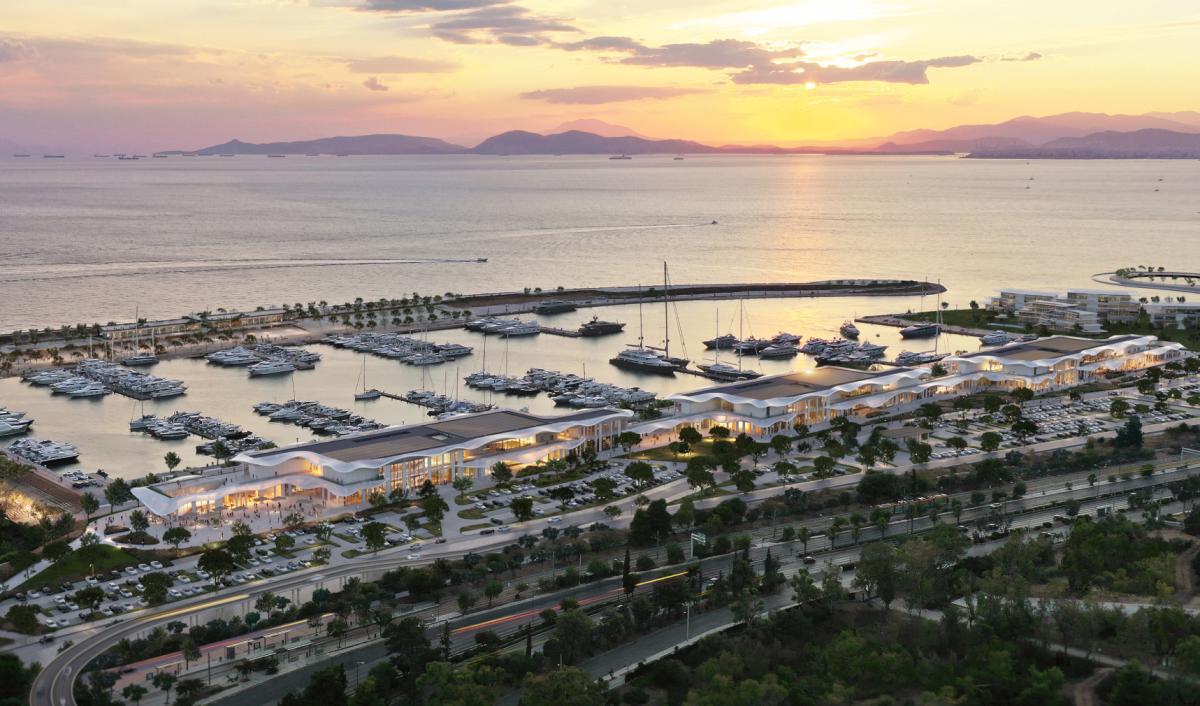
The Ellinikon will showcase the natural beauty of the Athens Coastal Front and link it to the new urban landscape that is being transformed. It is one of the largest urban regeneration projects in Europe, with a total surface area of 6.2 million m2. The new 15-minute smart city taking shape at the site of the former Ellinikon Airport will include:
- The largest coastal park in Europe and one of the largest ones worldwide, with a surface area that is 1.5 times that of London’s Hyde Park
- A new sandy beach accessible to all.
- The upgraded Agios Kosmas Marina, with berthing capacity for more than 300 yachts, set to become a landmark destination for the Mediterranean.
- Contemporary residences, luxury hotels, educational institutes, sports facilities, shopping destinations, cultural venues, recreational areas, offices and healthcare services.
In the area of Palaio Faliro, part of the Athens Coastal Front, we created Flisvos Marina, a benchmark destination that enhances quality of life and showcases a new model of marine tourism. With a berthing capacity for 310 yachts and countless fine-dining restaurants, cafés, recreational areas and selected shops, Flisvos Marina is a contemporary, vibrant destination that connects the Athens Coastal Front with the Greek islands.
With our projects we are investing in the future of the Athens Coastal Front and making a positive change in urban life.