
Ellinikon Airport: The story of a transforming Greece

Ellinikon Airport was once one of the most vibrant landmarks of modern Athens. For decades it served as Greece’s gateway to the world, a point of reference for thousands of travelers and a symbol of a golden era, when the country was spreading its wings towards progress.
Its journey through time tells the story of a Greece that's changing, developing and being transformed. From the first years of the airport’s operation in the early 20th century up to this day, with the development of the new The Ellinikon city, the area maintains one common thread: the ability to capture the transition from old to new, from vision to action.
From Tatoi to Ellinikon
Before Greece could even build an airport, it needed to define a direction for its civil aviation. In 1919, at the initiative of Eleftherios Venizelos, the country joined the international convention regulating air traffic and, over the next few years, the institutional framework was shaped for a new chapter in domestic and international transport.
Until the mid-1930s, all civil flights to and from Athens operated from the Tatoi military airport. However, frequent fog and difficult weather conditions, especially during the winter, quickly revealed its limitations and the need for a new, safer and more modern airport soon became apparent.
The solution was found in the semi-flat area between Alimos and Glyfada, at the foothills of Mount Hymettus, above the Agios Kosmas beach, known at the time as Chasani. The Ministry of Finance expropriated an area of 2,150,000 sq.m and 2 years later, on June 2, 1938, Ellinikon Airport was officially inaugurated. At the start of WWII, construction had not yet been completed. The final works and expansions took place during the period of the German-Italian occupation, to serve the military needs of the occupying forces.

The take-off years
After the end of the war, Greece entered a period of reconstruction. With the support of the Marshall Plan, Ellinikon Airport developed into one of the main pillars for modernizing the country’s infrastructure. The existing runway was extended, a second runway was built, the first modern air traffic control towers were installed and the foundations of the western terminal were laid.
In the 1950s, passenger and cargo traffic increased at an impressive pace. In 1956, domestic flights carried 167,000 passengers and international flights 293,000, while by the early 1960s these numbers had already doubled and tripled, respectively. During this period of growth, the construction of the East Terminal began and the facilities were inaugurated in 1969.
In the 1970s, the main runway was extended to 3,500 m, enabling the approach of larger aircraft and increasing traffic volume. By 1990, Athens International Airport at Ellinikon became Greece’s central gateway, with the capacity to welcome up to 12 million travelers a year.
At the dawn of the 21st century
In 2001, a large chapter came to a close: operations at Ellinikon Airport ceased, as the new Athens International Airport “Eleftherios Venizelos” in Spata had been completed. The last flight from Ellinikon Airport to Thessaloniki took place on March 28, 2001, one day following the inauguration of the new airport. On the following day, the first Olympic Airways flight from Montreal landed in Spata, marking the transition to a new era of air travel for Athens.
After operations stopped, the former airport site entered a phase of searching for a new identity. In 2004, it was used as part of the Olympic facilities, hosting 6 sports venues: baseball, canoe-kayak slalom, indoor court, fencing arena, softball field and hockey field.
In 2015-2017, during the peak of the refugee crisis, some of the facilities were converted into refugee camps. Later on, some areas were used to house services and offices, as well as exhibitions and cultural events. However, a large part of the buildings and infrastructure remained inactive.
In the years that followed, the discussion surrounding the redevelopment of Ellinikon gained new momentum. A site which served as a symbol for progress and outward-looking growth for decades was about to be transformed again.
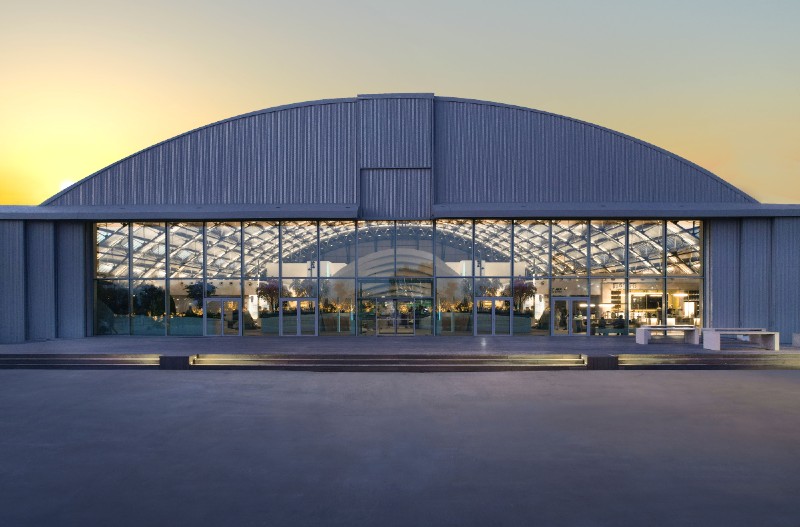
The Ellinikon: The city turns a new leaf
In the summer of 2021, LAMDA Development began works on the regeneration of the former Ellinikon Airport site. Across an area spanning 6.2 million sq.m., LAMDA Development is creating The Ellinikon, one of the largest urban regeneration projects in Europe to date.
The Ellinikon is set to become a modern, smart city, sprawling around the largest coastal park in Europe. The development, which is designed and implemented based on the principles of sustainability and innovation, includes modern residences, a mall, luxury hotels, educational institutes, sports centers, shopping destinations, cultural and entertainment areas, offices and healthcare facilities.
The goal of LAMDA Development is for this new 15-minute city to transform the urban landscape, upgrade the daily life of residents and visitors by redefining city life, and give an extra boost to the Athens Riviera. It is estimated that when The Ellinikon is fully developed, 80,000 new jobs will be created, attracting further investments and giving rise to new business opportunities.