
Skyscrapers: when cities reach for the sky

When we think of New York, Hong Kong, Shanghai or Dubai, the image of high-rise buildings and a breathtaking skyline automatically pops to mind. However, skyscrapers were not always taken for granted.
They were a choice that came with the industrial revolution. Technology brought steel frames and the elevator, the rapid urban expansion brought the need to grow upwards and human ambition took care of the rest. So, the way we build, live in and imagine the city changed forever.
The battle to conquer the skies
The history of skyscrapers started in 1885 in Chicago, a city that turned into a white canvas after the Great Fire of 1871. The need for fast reconstruction, the technological advancements and the coming together of innovative architects created the ideal conditions for experimentation.
At just 10 stories and around 42 meters tall, the Home Insurance Building may not seem particularly impressive by today’s standards, but it paved the way for a new era. As the first building to use a steel frame rather than load-bearing masonry walls, it proved that height was no longer a question of material strength, but of ambition and vision.
New York quickly took up the baton. Given Manhattan’s much greater economic power and acute lack of space, vertical development became more of a necessity than a choice. The Flatiron Building (1902) with its triangular shape instantly became a symbol of the modern city. In 1930, the Chrysler Building managed to earn the title of the tallest building at 319 meters, thanks to the huge metal antenna added by its architect, William Van Alen, who changed the original design. About 11 months later, the Empire State Building broke that record, with 381 meters.
Skyscrapers transcended the confines of a mere building and transformed into a statement of economic power, technological superiority and ambition.

Symbol of power or contemporary need?
For many decades, skyscrapers mostly remained symbols. They were chosen by large corporations and banks for their headquarters. The rationale was simple: the higher you are, the more powerful you look.
This changed gradually, when large cities started to face the consequences of rapid development. The land in large urban centers became scarce and expensive, populations soared and horizontal expansion came at an environmental cost. The skyscraper evolved from a symbol of prestige into a practical solution.
At the same time, the nature of the building itself began to change. Modern high-rise buildings are no longer only for offices. They have become vertical cities with residences, hotels, shops, restaurants. The mixed-use tower idea is not just an architectural trend; it is the modern city’s answer to the space problem.
Iconic skyscrapers on the global skyline
Today, the construction of skyscrapers is a global phenomenon, with the tallest buildings no longer found in New York and Chicago, but in Asia and the Middle East.
Hong Kong holds the title of the city with the most skyscrapers in the world. In Dubai, Burj Khalifa, at 828 meters, holds the title of the tallest building in the world since 2010. Next come Merdeka 118 in Kuala Lumpur, at a height of 679 meters, and the Shanghai Tower at 632 meters, two structures that embody Asia’s economic rise in the most visible way. That said, the battle to conquer the skies is not over yet. The Jeddah Tower in Saudi Arabia is expected to reach a height of 1,000 meters, while Burj Mubarak Al Kabir in Kuwait aspires to reach 1,001 meters.
But height is no longer the only requirement. High-rise buildings are now required to be sustainable as well. Bioclimatic design, green facades, energy-saving systems and smart technologies are gradually transforming skyscrapers into urban sustainability models.
Skyscrapers in the Greek context
In Greece, vertical development was primarily expressed through the apartment buildings in Athens. Strict zoning regulations did not allow for the development of high-rise buildings. A brief exception was a 1968 law which temporarily relaxed the limits and led to the few high-rise buildings that still exist today.
One such typical example is the Athens Tower, the tallest building in the country, at 103 meters, which houses offices and businesses. The Piraeus Tower and the Apollo Tower also stand out on the Attica skyline. The Apollo Tower is the tallest residential building in Greece, also known for its hidden 13th floor, a result of the superstition of its first residents.
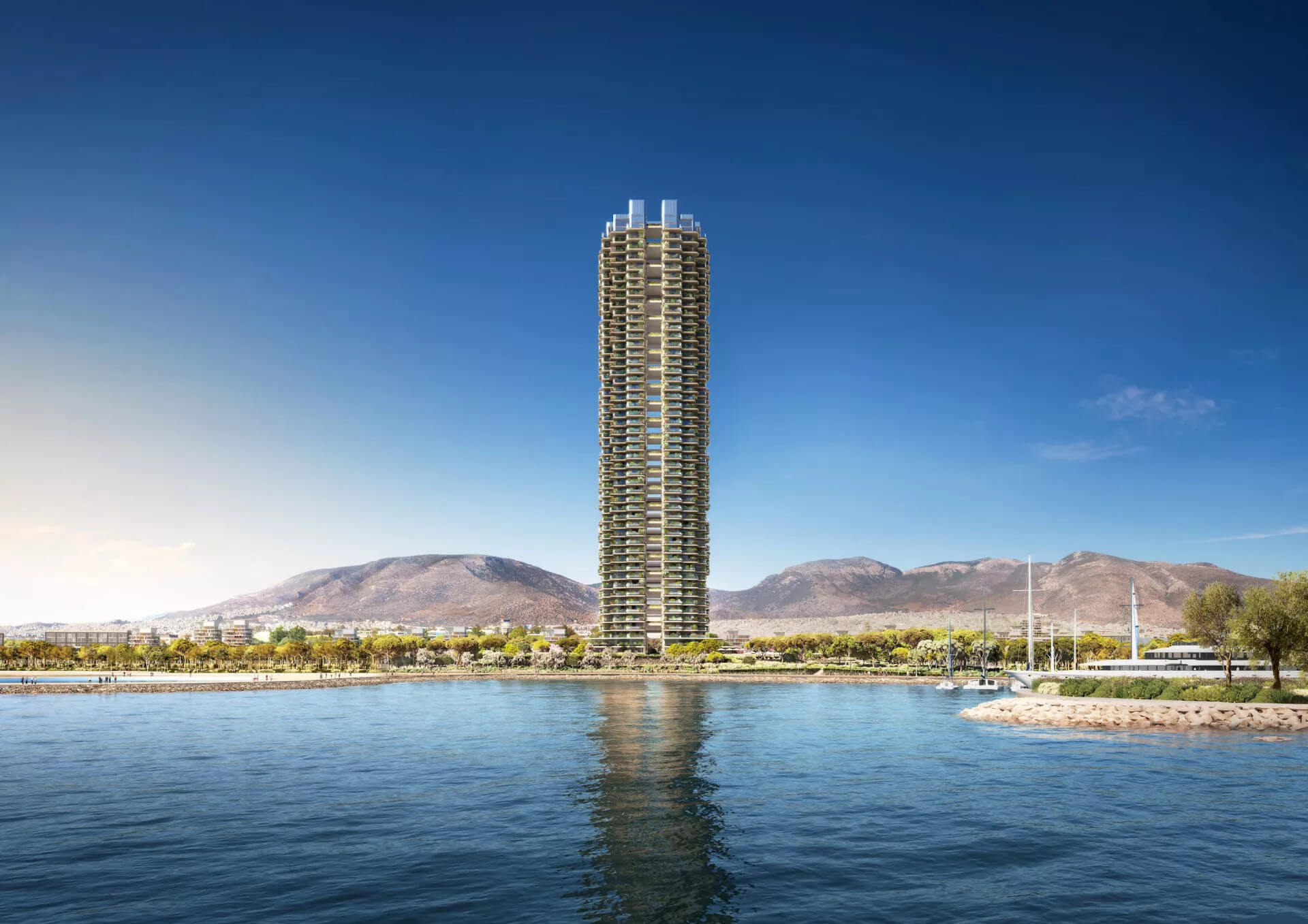
However, the future is moving in a new direction. The Riviera Tower at The Ellinikon aspires to become a gamechanger. At a height of 200 meters and with around 50 stories, it will be the first green residential skyscraper in the country. Its 173 residences, with a panoramic view over the Athenian Riviera, the Acropolis and Sounio, integrate biophilic design principles and signal a shift towards a new era of urban development in Greece.
This project confirms that, at LAMDA Development, we are ready to take the next step. Because we know that what matters is not only building higher, but living better within the spaces we create.